Best Bank Fishing Near Tulsa: How to Find Productive Shoreline Water
You don’t need somebody’s secret spot to catch fish from the bank. You need to understand what makes a piece of shoreline worth fishing.
When you’re bank fishing, you don’t have the freedom to move around like a boat angler. That makes your ability to read the shoreline even more important. Current, depth, structure, shade, wind, forage and changes in the bottom can all tell you where to make your next cast.
This guide isn’t a list of secret fishing spots. It’s a system you can use to find productive bank water around Tulsa and throughout Oklahoma.
Why Bank Fishing Is Great in Oklahoma
One of the best things about bank fishing is that you don’t need a boat, electronics, or a big pile of gear to have a good day on the water. Oklahoma has reservoirs, rivers, creeks, public fishing areas, city lakes and ponds that can be reached on foot.
Bank fishing also forces you to become a better angler. When you can’t move around with a trolling motor, you have to pay attention to the water in front of you. You start noticing current, depth, wind, shade, structure, baitfish and changes in the shoreline.
Once you understand why fish use a particular piece of water, you can start finding similar opportunities on a lake you’ve never fished before.
Essential Bank Fishing Gear
You can bank fish with almost anything, but a simple setup makes it easier to cover water and adapt when conditions change. You don’t need to carry your entire tackle room down the shoreline.
Rod and Reel
A medium or medium-light spinning setup is a good all-around starting point for many Oklahoma bank anglers. It can handle small jigs, soft plastics, spinners, crankbaits and live-bait rigs without making light presentations unnecessarily difficult.
If you prefer a baitcaster, a medium or medium-heavy setup can give you more power for larger bass baits, heavier jigs and situations where you need to control a fish around cover. The important thing is to use equipment you can cast accurately and comfortably for several hours.
Fishing Line
There is no single line that is right for every bank-fishing situation. Monofilament is inexpensive and forgiving. Fluorocarbon can be useful when you want a less visible leader or more direct contact with a lure. Braided line provides strength and sensitivity, particularly around cover, but many anglers pair it with a leader.
Baits and Lures
Keep the tackle selection simple. A few proven options can cover a surprising amount of Oklahoma bank water:
- Soft plastics for bass and other predators
- Small jigs and spinners for a variety of species
- Crankbaits for covering rocky banks
- Swimbaits and flukes for baitfish imitations
- Live bait where legal and appropriate for the species
- Cut bait when targeting catfish
- Bobber-and-bait rigs when you want a simple presentation
The best bait is often the one that lets you efficiently test the water you have found. If you can’t explain why you’re throwing a particular lure, change something.
Finding Productive Bank Fishing Spots
Before you ever make a cast, look for things that create a reason for fish to be there. A long stretch of identical shoreline gives you very little information. A point, creek mouth, bridge, dam, riprap transition, shade line or depth change gives you something to investigate.
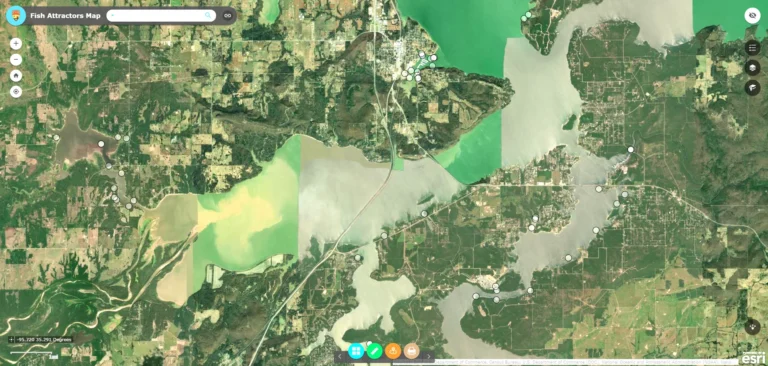
Maps and satellite imagery can help you find these features before you leave home. Once you arrive, use the water itself to confirm what you saw on the map.
The question I want you to ask is simple: what is different here?
That one question can keep you from walking a mile of shoreline and making the same cast 200 times.
1. Dams and Spillways
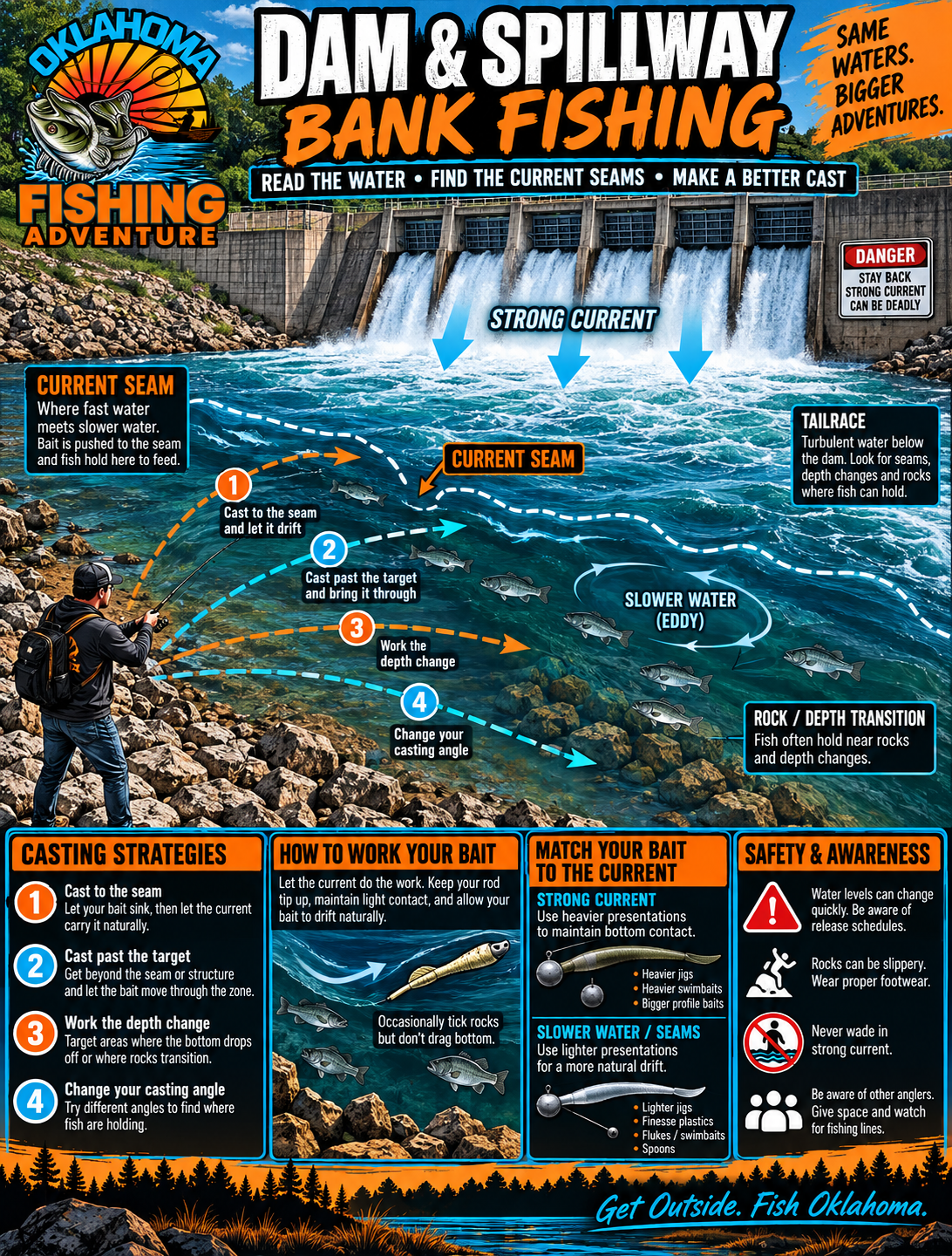
Dams and spillways are some of the easiest places to understand once you start thinking about what the water is doing instead of simply casting toward the dam.
Current concentrates water movement and can concentrate forage. Fish don’t always want to sit in the strongest current, though. Look for current seams, edges, eddies and breaks where fish can hold while still getting access to food moving through the current.
Let the Current Do the Work
When you’re throwing a fluke, swimbait or similar presentation in current, you don’t always need to burn it back to shore. Let the current help move the bait while you maintain enough tension to feel what it is doing.
Your bait should occasionally tick rocks or other bottom structure, but it shouldn’t spend the whole retrieve dragging across the bottom. Adjust the weight to the current. Stronger current generally requires a heavier presentation to keep control.
Depth is another variable you can control. Let the bait sink for a few seconds, make the cast again with a different countdown, and pay attention to where you get bites.
Where Should You Cast?
Don’t automatically make your longest cast. Start close and work outward: short, then medium, then long. Fish may be holding surprisingly close to the bank or near the first current break.
Look for the seam where fast water meets slower water, rocks or depth changes, and places where the current is interrupted. Those are better targets than simply throwing as far as possible.
Bird activity can also be a clue. Birds feeding near the surface can indicate baitfish are present. Don’t cast at the birds; figure out what is attracting the bait and predators to that area.
Safety Comes First
Dam and tailwater conditions can change quickly. Follow posted access restrictions and current regulations, stay out of closed areas, and never assume the water below a dam is behaving the same way it did the last time you visited.
2. Lake Bridges
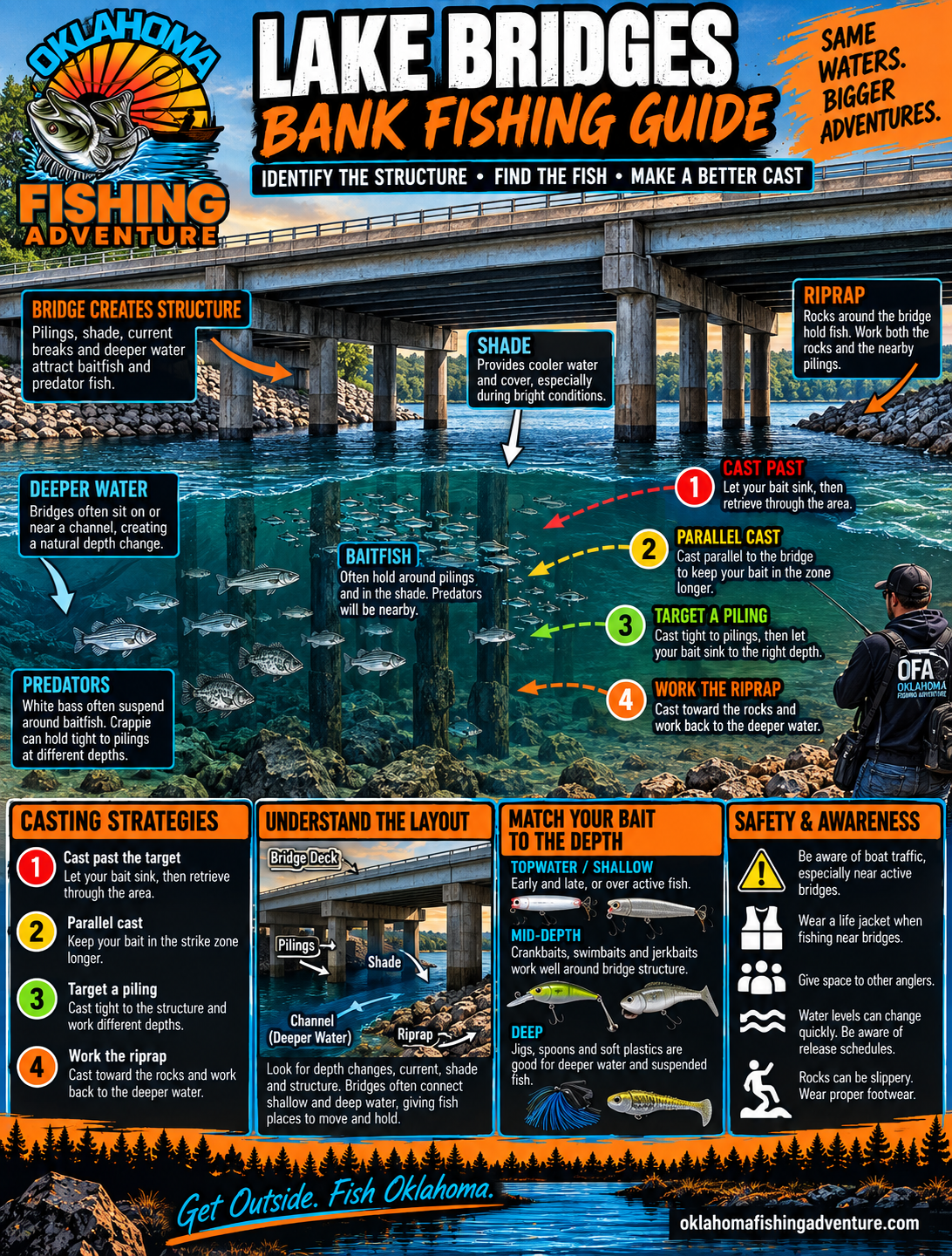
A bridge isn’t automatically a good fishing spot just because it’s a bridge. What matters is what the bridge does to the water.
Bridges can create shade, hard structure, depth changes, channel edges, riprap and funneling that changes how water and forage move. Your job is to identify the actual target.
Don’t Just Fish Under the Bridge
Look for pilings, the edge of the shade, riprap, a depth change, a creek channel or an approach that creates a point or funnel. If you’re targeting a piling, don’t necessarily cast directly at it. Cast past it and bring the bait alongside the piling so it stays in the productive zone longer.
The same idea applies to riprap. A cast straight toward the rocks may only keep the bait in the zone for a few seconds. A parallel cast can keep a lure working along the rock much longer.
Shade Matters, but It Moves
Look at where the shade actually falls. The productive side of a bridge can change as the sun moves. Fish the shade and the edge where shade meets brighter water rather than assuming every part of the bridge is equally useful.
Fish Species Don’t Always Use Bridges the Same Way
Crappie often relate closely to pilings and other hard structure. White bass may suspend in open water while following baitfish. Largemouth bass may use shade, riprap, wood and nearby depth changes.
For suspended white bass, don’t assume you need to cast directly at structure. Watch for baitfish or surface activity and work a swimbait, fluke or small jig through different depths. Distance from shore and depth in the water column are two different variables.
Use Your Casts to Learn
Start close, then work farther out. Change one variable at a time: same cast with a different depth, same depth with a different retrieve, same retrieve with a different angle, or the same angle with a different lure.
When you get a bite, remember the reference point that produced it: a piling, tree, rock, shade edge or shoreline feature. That makes a successful cast repeatable.
If you can’t explain why you’re making a cast, make a different cast.
A public bridge or road does not automatically mean public fishing access. Verify that you can legally park and access the shoreline before you start fishing.
3. Riprap Banks
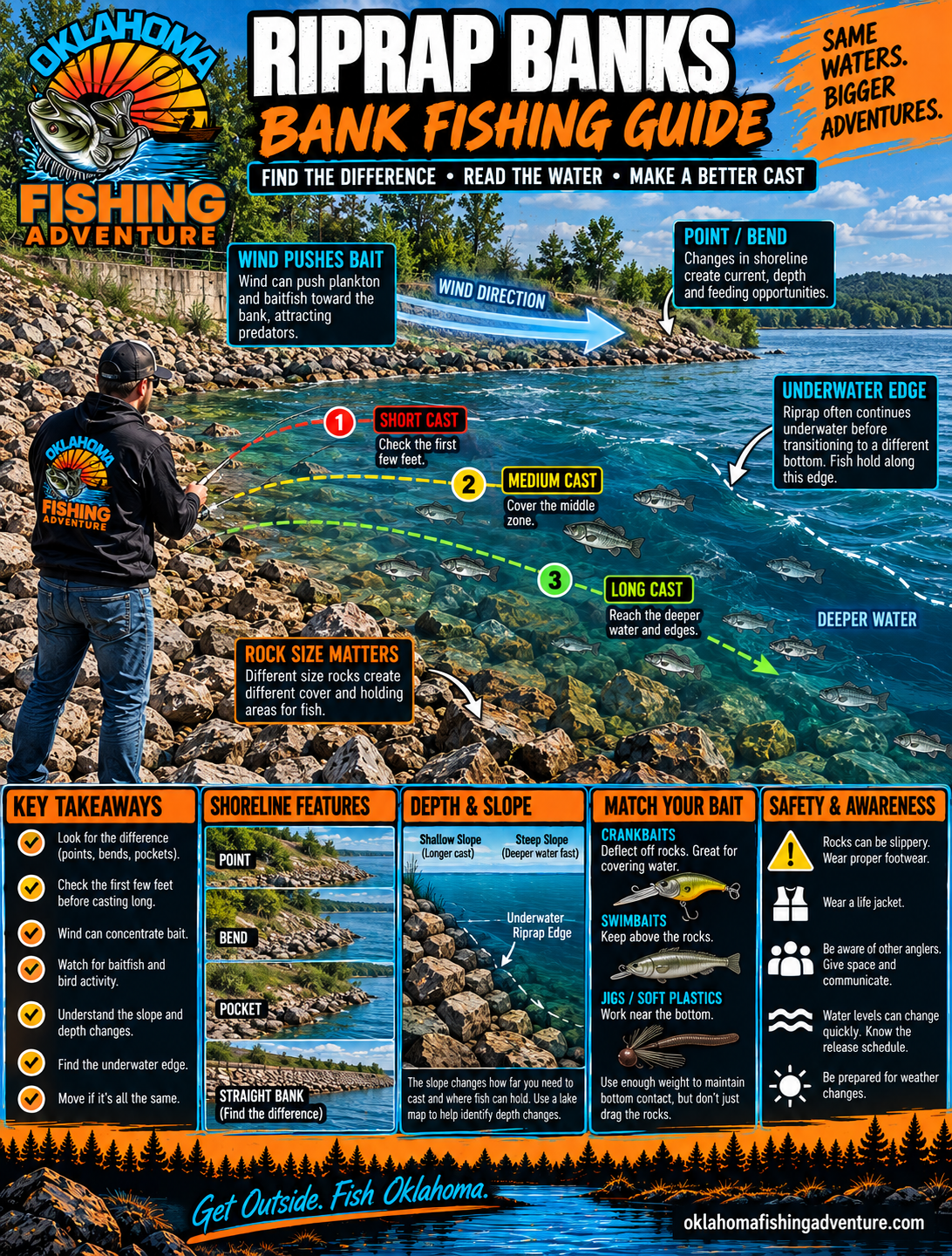
Riprap can look boring from shore because a long bank may appear to be nothing but the same rocks from one end to the other. That’s exactly when you need to find the difference.
In Oklahoma reservoirs, riprap can overlap with submerged habitat and other structure. The visible rock is only part of the picture. The line where the riprap ends underwater can be an important transition.
Find the Difference
Look for a point, bend or corner. Look for larger rocks mixed into smaller ones. Find places where the riprap extends farther into the lake, where the slope changes, where a pocket or indentation forms, or where a creek, drain or other shoreline feature intersects the rocks.
Water depth matters too. A steep riprap bank can put deeper water surprisingly close to shore. A shallow slope can create a much longer shallow zone. Water level changes can also change how much rock is exposed and where the underwater edge sits.
Wind Can Make a Riprap Bank More Interesting
Wind can push surface food toward a shoreline. When food concentrates, baitfish may follow, and predators may follow the baitfish. That’s not a guarantee that every windy bank will be better, but it gives you a reason to look at windward shorelines differently.
Work the Water Column
“Fish the rocks” doesn’t mean dragging every lure across the bottom. With a jig or soft plastic, you may want to get closer to bottom. A swimbait can be worked above the rocks. A crankbait can occasionally contact rock as it moves through the zone.
Short Casts Are Important Here Too
Don’t walk up to a riprap bank and immediately fire the lure as far as possible. The first few feet of water can be productive, especially where rocks drop into deeper water close to shore.
Start close. Then work medium distance. Then work long. Change your casting angle so the lure stays in the productive zone as long as possible.
When Should You Move?
If you’ve worked a long, uniform stretch and can’t identify wind, bait, a depth change, cover, a rock-size change or another transition, don’t be afraid to move. Bank fishing rewards anglers who find the difference rather than simply covering the most shoreline.
How to Find Your Own Bank-Fishing Water
You don’t need a secret list of GPS coordinates. You need a repeatable process.
- Start with a map and identify dams, bridges, creek channels, points, riprap and access.
- Look at satellite imagery for shoreline changes, visible structure and places where roads or channels influence the lake.
- Use lake-depth maps when available to find drop-offs and changes in contour.
- When you arrive, watch the water before you cast. Look for current, wind, shade, baitfish and bird activity.
- Start close and work outward instead of assuming the fish are far away.
- Control depth with sink time and keep track of your countdown.
- Change one variable at a time so you know what actually caused the bite.
- When you find a productive cast, identify the reference point that made it productive and repeat it.
The most important habit is simple: find the difference.
If everything along a shoreline looks the same, find the one thing that isn’t. A current seam. A shade edge. A piling. A point. A change in rock size. A deeper pocket. The underwater edge of riprap. A creek channel. Wind pushing into a bank.
Best Oklahoma Lakes for Bank Fishing
There is no single “best” bank-fishing lake for every angler. Access, species, season, water level and the particular shoreline you can legally reach all matter.
For anglers in and around the Tulsa area, Skiatook Lake, Keystone Lake and Oologah Lake are natural places to start researching. Skiatook offers a variety of species and public-use areas, while Keystone has a large amount of shoreline and public access. Oologah provides another large reservoir option north of Tulsa.
Farther across Oklahoma, Grand Lake, Tenkiller, Fort Gibson, Lake Texoma and many ODWC public fishing areas provide additional opportunities. The point is not to memorize a list of lakes. Use the same process at each one: find legal access, identify a change in the water, and then figure out why fish should be using it.
ODWC maintains lake and access information through its Where to Fish resources. Check the current lake information and regulations before planning a trip.
Seasonal Bank Fishing Strategies
Spring
Spring is a transition period. Water temperatures can change quickly, and fish may move between shallow and deeper water as conditions change.
Look for warming shallow areas, wind-blown banks, creek mouths and places where shallow water is close to deeper water. On rivers and tailwaters, pay attention to current and water temperature.
Summer
Summer often makes shade, deeper water, current and low-light periods more important. Early morning and evening can be productive, but don’t automatically ignore the middle of the day. A bridge shadow, deep bank, current break or wind-blown shoreline can still give fish a reason to be active.
Hot Oklahoma weather also means you need to manage yourself. Bring water, protect yourself from the sun and know when it’s time to call it a day.
Fall
Fall can be an excellent time to explore bank water because changing temperatures and forage movements can make fish more active. Watch for baitfish, wind-blown shorelines and areas where creeks or channels meet the main lake.
Winter
Winter bank fishing is often about slowing down and finding stable water. Deeper areas, channels, steep banks and places that hold heat or provide protection can become more important.
Cold water doesn’t mean fish stop feeding. It means you may have to slow your presentation, change depths and be willing to spend more time working a smaller area.
Bank Fishing Safety
Bank fishing looks simple, but some of the most productive shoreline can also be some of the most dangerous. Rocks, steep banks, mud, current, slippery algae and changing water levels deserve respect.
- Wear shoes with good traction.
- Be especially careful on wet riprap and steep banks.
- Keep children close to the water and use appropriate flotation equipment where needed.
- Watch the weather and leave before lightning or dangerous storms reach you.
- Use extra caution around dams and moving water.
- Tell someone where you are going when fishing remote areas.
- Carry water, sun protection and a basic first-aid kit.
Oklahoma Fishing Regulations and Shoreline Access
This is one area where bank anglers need to be particularly careful. A shoreline that looks accessible from a map is not necessarily public fishing access.
Oklahoma regulations generally require anglers to have a valid fishing license unless exempt, and shoreline access can be subject to property rights and posted restrictions. Check Oklahoma fishing regulations and the rules for the specific water you plan to fish.
Do not assume that a public road, bridge or parking area gives you permission to cross private property to reach the water. Use established public access, posted access points or other legally authorized access.
ODWC also operates the Oklahoma Land Access Program, which provides designated public access on enrolled private properties. Those properties have their own access rules and require the appropriate permits.
Frequently Asked Questions About Bank Fishing
Do I need a boat to catch fish in Oklahoma?
No. A boat gives you access to more water, but bank anglers can catch bass, crappie, catfish, white bass, sunfish and other species from legal shoreline access.
What is the best bait for bank fishing?
There is no universal best bait. Match your presentation to the species, water conditions and structure you are fishing.
How do I find good bank-fishing spots?
Look for differences: current, depth changes, points, creek mouths, bridges, riprap, shade, wind, baitfish and other structure. Then verify that you can legally access the shoreline.
Should I always cast as far as possible?
No. Fish can be surprisingly close to shore. Start with short casts and work farther out. Change your casting angle and retrieve so you can keep your bait in productive water longer.
Can I fish from any bridge?
No. A bridge or public road does not automatically make every adjacent shoreline or structure legal to access or fish. Verify access and obey posted restrictions.
What is the biggest mistake bank anglers make?
Spending too much time fishing water that has no obvious reason to hold fish. Instead of asking how much shoreline you can cover, ask what makes this particular piece of shoreline different.
Related Oklahoma Fishing Adventure Resources
These are resources that can help you take the same approach farther. Some are specific lake or species guides; others show you how to research water before you ever leave home.
- How to Find Fishing Spots with Google Earth and Navionics
- How to Find Free Oklahoma Brush Pile Waypoints
- How to Fish Oologah Dam in Oklahoma
- Early Spring Fishing on Skiatook Lake, Oklahoma
- How to Catch Bluegill on Skiatook Lake, Oklahoma
- How to Catch Oklahoma White Bass During the Spring Spawn
- How to Catch White Bass at Keystone Lake, Oklahoma
- How to Use Depth Shading to Find Fish Faster
- Beginner’s Gear Checklist for Fishing Oklahoma Waters
Take This With You
The goal is not to memorize a list of places. It is to learn a process you can use on the next lake, pond, river or shoreline you visit.
Start close to shore. Find the first difference in the water. Make a few purposeful casts. Change one variable at a time. When you get a bite, figure out what made that cast different.
That’s how you stop fishing the bank and start reading it.
Oklahoma Fishing Adventure — Get Outside. Go Fishing. Make Your Own Adventure.